.png)
Your post isn't competing for likes anymore. It's competing for a citation.
For a decade, LinkedIn rewarded behaviour. Likes were points. Comments worth more. Dwell time nudged you up the feed. You optimised for a scoreboard, and it optimised back.
That game is over.
In late 2024, LinkedIn quietly deployed 360Brew, a 150-billion-parameter decoder-only foundation model built on Mixtral 8x22B and fine-tuned on professional context: profiles, posts, jobs, skills, interactions. Paired with a separate LLaMA-3-based retrieval model, the feed now runs as a two-stage LLM pipeline. A Causal LLM narrows roughly 300 million daily posts to about 2,000 candidates per user in under 50 milliseconds. Then 360Brew reasons about those 2,000 and decides what you see.
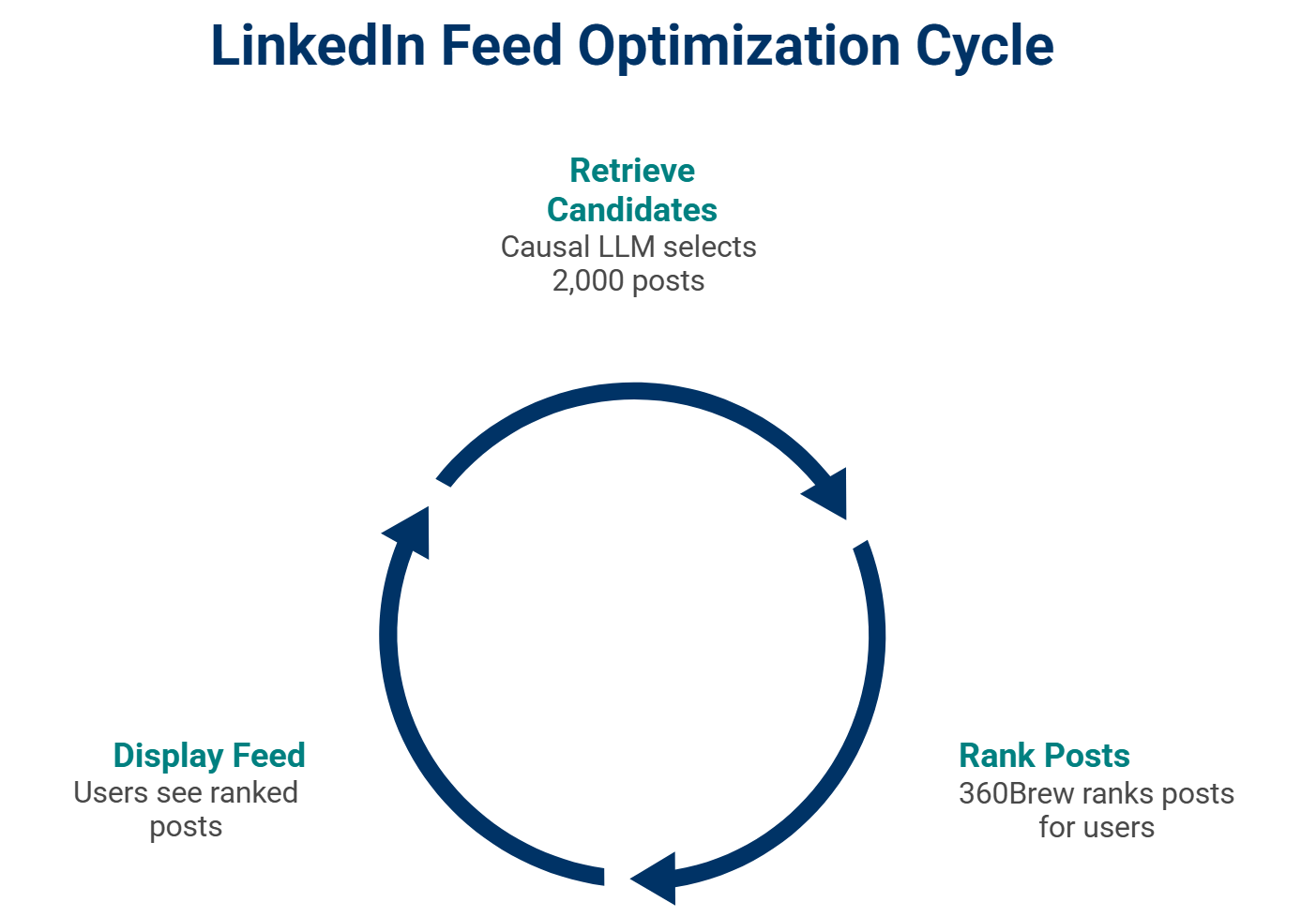
Two LLMs are reading the platform. Yours is one of 1.3 billion profiles they're reading.
The new question isn't "did people engage?"
It's "did the model understand?"

The same shift is hitting open search. ChatGPT now handles over 2 billion queries a day. AI-referred sessions to websites grew 527% year-on-year through mid-2025. Discovery is decoupling from clicks. People (and the systems they talk to) want the answer, not the link.
The discipline that emerged to solve this has a name: Answer Engine Optimization. Structure content so AI engines can extract, trust, and cite it. Most marketers think of AEO as a Perplexity or Google AI Mode play.
That's a misread.
LinkedIn is an answer engine now too. The 360Brew pipeline does what a citation model does: read semantically, rank against a person's professional intent, surface the source. To be the answer inside the feed, you optimise for two systems, not one.
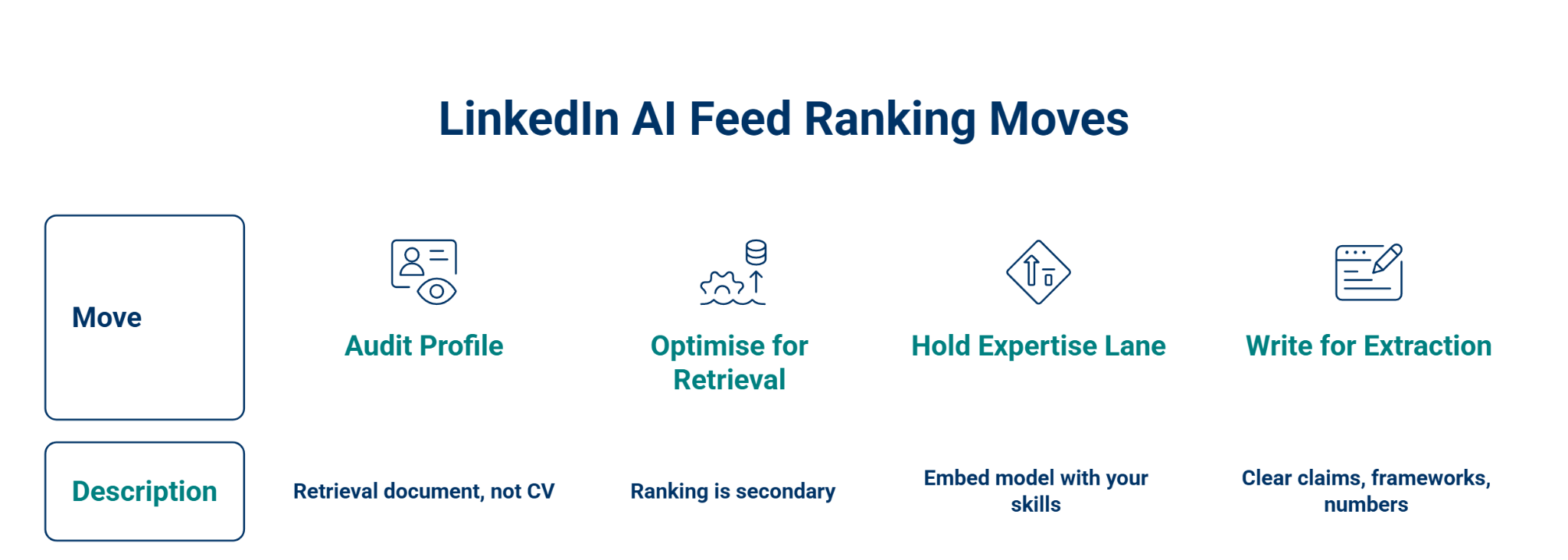
Four moves that change your reach:
1. Audit your profile as a retrieval document, not a CV. LinkedIn's own engineering research confirms LLMs weight the start of any input most heavily. The first line of your About and the first sentence of every post are prime semantic real estate. Vague headlines like "Driving impact through innovation" tell 360Brew nothing about which 2,000 conversations to slot you into. Specific ones that name the sector, the buyer, the problem give the model something to anchor on. Your profile is read on every ranking decision. It's infrastructure, not biography.
2. Optimise for retrieval first, ranking second. Most LinkedIn advice still targets 360Brew, the ranker. But if your post doesn't make the 2,000-candidate cut, ranking is irrelevant. The retrieval LLM reads embeddings of your profile and content. Thin, generic profiles produce weak embeddings. Most accounts lose visibility one layer earlier than they realise.
3. Hold one lane long enough for the model to embed you. Active weekly posters on LinkedIn grew from 0.9% to 1.1% of users. The pie got bigger; your slice got smaller. Topic-hopping splits your embedding across too many vectors and weakens all of them. Three months on one narrow lane beats a year of breadth. The model rewards topic gravity, not volume.
4. Write for extraction. The content that earns a citation from ChatGPT (a clear claim, a number, a named framework, a definition) is what 360Brew can confidently surface. Lead with the answer. Support with evidence. Name concepts precisely. Engagement bait now costs you: "Agree?" hooks inflate comments for an hour and depress your authority signal for months, because 360Brew reads the comments semantically and notices when responses don't match.
What this means for the operator
LinkedIn's feed isn't getting smarter. It's getting more literal. It rewards people who treat their professional surface (profile, posts, comments, even who they reply to as one coherent input to a model reading every word.
The leading indicator for 2026 isn't engagement rate. It's citation frequency: how often your content gets surfaced, paraphrased, or referenced inside AI-mediated summaries, on LinkedIn and beyond.
That work is engineering, not posting.
It's where Linkenite operates. We build the agentic systems that turn content, outreach, and signal into an operating layer your team runs, not a campaign someone has to remember every Tuesday.
If your LinkedIn presence is still being managed like a 2022 content calendar, you're competing in the wrong system.


.png)
.png)
.png)
.png)
.png)
.png)
.png)
.png)
.png)
.png)
.png)
.png)

.png)
.png)
.png)
.png)


.png)
.png)

.png)


.jpg)

.jpg)
.jpg)


.png)


.png)

.png)
.png)
.png)


.png)
%20(2).png)
.png)
.png)




.png)

.png)


.png)


.png)


.png)


%20BLOG%20BANNER.png)


.png)